Iranian Oil Tankers Amass Off Sri Lanka Amid Tightened US Blockade
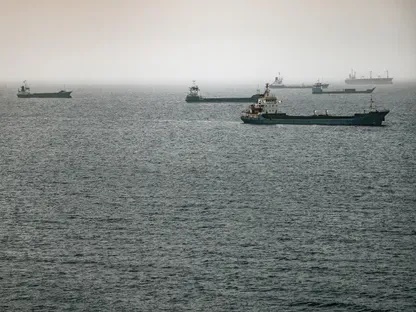
More than a dozen Iranian-flagged oil tankers have gathered off the coast of Sri Lanka, following the tightened US blockade that has restricted maritime traffic to and from Iranian ports, effectively halting a significant portion of Iran's oil exports. This shift in Iranian tanker routes coincides with Washington's intensified sanctions against Tehran during the ongoing conflict, while Iran continues to partially close the Strait of Hormuz, raising concerns that mutual economic and military escalation could lead to further disruption in global energy markets and trade. Ship tracking data indicates that approximately 13 Iranian tankers are anchored on the fringes of Sri Lanka's territorial waters, alongside other vessels linked to Iran's "shadow fleet," as the US blockade prevents ships dealing with Iranian ports from returning home. These measures were first imposed in April and then reactivated in July following the collapse of a month-long ceasefire, according to press reports. Samir Madani, co-founder of the maritime intelligence firm TankerTrackers.com, stated that "a fleet of about 20 state-owned Iranian tankers, all empty, has sought refuge in Sri Lanka's exclusive economic zone." He added that the vessels' draft levels suggest they are devoid of cargo, increasing the likelihood of their return to Iranian waters for oil loading, which would render them "vulnerable to attacks," citing a pattern observed in previous airstrikes carried out by US Central Command (CENTCOM) against Iranian tankers. The blockade has become one of the most effective US tools for pressure on Iran, curbing Tehran's ability to import fuel and generate oil export revenues. However, it has so far failed to fully reopen the Strait of Hormuz or end the conflict that began last February. In a related development, US Treasury Secretary Scott Pisent announced on Monday that Washington would escalate pressure on Tehran by expanding secondary sanctions to include entities doing business with it, describing the move in an analytical article as a "sweeping economic offensive." As of August 24, US forces reported redirecting 71 commercial vessels away from Iran, disrupting three ships, and boarding two others "to ensure compliance" with the blockade. Since mid-July, no tanker bound for outside the Gulf region has loaded oil from the main export facility at Kharg Island, according to data from the commodities intelligence platform Kpler. Conversely, the number of empty tankers off the southwestern coast of Sri Lanka and near Pakistan has notably increased. Additionally, 48 other tankers are currently stopped off Malaysia, which the US organization United Against Nuclear Iran (UANI) claims have been involved in Iranian crude trade. These vessels are located in an anchorage area traditionally used by Iranian tankers to transfer their cargoes to Chinese ships bound for independent refineries, known as "teapots," in China. Analysts have reported that the tankers off Sri Lanka are moving along the country's territorial water boundaries, in anticipation of the approach of US Indo-Pacific Command forces. Under international law, the United States generally cannot attack vessels within the territorial waters of a neutral state, which extend 12 nautical miles from the coast. Last March, an Iranian frigate, the "Dina," was sunk by a US submarine approximately 19 nautical miles off the Sri Lankan coast. For its part, Sri Lanka's Ministry of Ports and Shipping stated it was unaware of a gathering of Iranian tankers off the nation's coasts, while the Ministry of Foreign Affairs and a Colombo Port official did not respond to requests for comment. Brett Erickson, managing partner at Obsidian Risk Advisors, cautioned that while the US blockade has successfully halted Iranian vessel traffic, it is unlikely to achieve its goal of reopening the Strait of Hormuz. He also warned that Pisent's announced "sweeping economic offensive" could provoke an "Iranian response that would shatter the global economy."