Ceuta Crisis Escalates: Italy Threatens Schengen, France Bolsters Borders
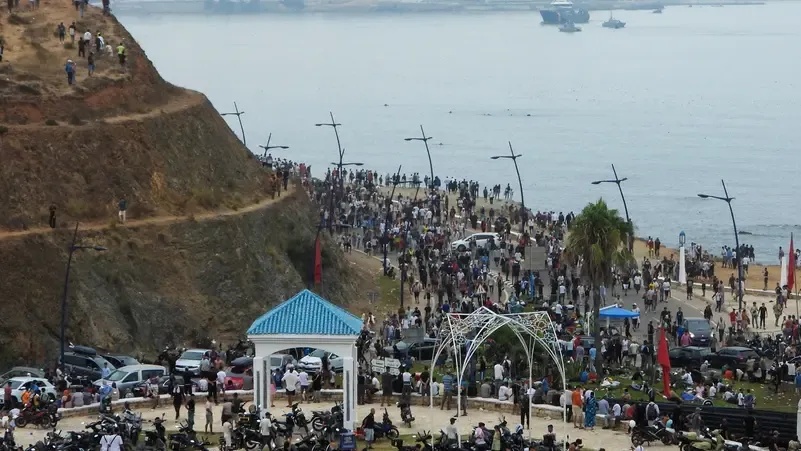
The migration crisis in the Spanish city of Ceuta has escalated into a deepening European issue, following a massive wave of mass crossings witnessed in the region. This prompted Madrid to deploy military forces and strengthen its security measures. The repercussions of this crisis have extended to other European Union member states, with France tightening controls on its borders with Spain, and Italy and Finland escalating their rhetoric regarding the Schengen Agreement. These developments followed estimates from the Spanish Interior Ministry indicating that approximately 49,000 migrants entered Ceuta within 24 hours, in a wave described as exceptional, placing the city, located north of Morocco, under immense pressure. Ceuta is considered one of the rare land gateways between the African continent and the European Union, making it a primary magnet for migrants seeking to reach European territories. The mass crossing wave into Ceuta was not without human cost, as international reports indicate the death of at least 18 migrants during attempts to cross the border from Morocco into the Spanish enclave. These cases included fatalities from drowning and stampedes during the mass crossings. Local authorities faced significant pressure due to the overwhelming numbers of arrivals. **Spanish Army Deployment** Spain announced the deployment of army units to Ceuta to support security forces and the Civil Guard, after the influx volume exceeded the local authorities' capacity to handle the large number of arrivals. This deployment is part of measures to contain the crisis, coinciding with ongoing coordination between Madrid and Rabat to halt new flows and control the security situation in the region. Spanish authorities clarified that this deployment aims to support security forces and enhance border control, with law enforcement duties remaining the responsibility of the police and Civil Guard. **Cooperation with Morocco** In parallel with Spanish measures, cooperation with Morocco was strengthened to contain the crossing wave, given that the Moroccan side represents the main point of departure for migrants heading to Ceuta. Cooperation between Madrid and Rabat gains particular importance due to the city's location, being a Spanish enclave within North Africa, and, along with Melilla, forming almost the only land border between the European Union and the African continent. The crisis was not limited to the security aspect, as the crossing wave brought severe humanitarian risks, with casualties occurring during attempts to reach the city, amid warnings about the danger of mass crossings. International reports indicated that the immense pressure on the city caused a severe reception crisis, with large numbers of migrants arriving in a short period. **European Repercussions and Italian-Finnish Escalation** The crisis's repercussions extended to France, which began tightening security measures on its borders with Spain, fearing the spillover of the migration wave into its territory via the Schengen area. This French move comes amidst European concerns that the Ceuta crisis could lead to additional pressure on the internal borders of the European Union, at a time when the Schengen Agreement allows for free movement between member states. In a notable political development, Italy and Finland joined the crisis discussion. Italian Prime Minister Giorgia Meloni, on Thursday, called for suspending Spain's membership in the Schengen area due to the entry of hundreds of irregular migrants. Finland subsequently supported Italy's request to exclude Spain from the Schengen area due to the Ceuta crisis. Meloni stated on her official X account: "We are in the process of gathering relevant parties, and once meetings conclude, we will be ready to act, including taking exceptional measures... such as suspending the Schengen Agreement with Spain." The Italian Prime Minister added that images of migrants arriving from Ceuta were "shocking," with most, including children, having to swim to reach there. Meloni also criticized the Madrid government's decision to grant Spanish, and thus European, citizenship to over 500,000 irregular migrants, deeming it a "grave error" that encouraged human trafficking. For his part, Matteo Salvini, Italy's Deputy Prime Minister and leader of the far-right League party, called for suspending the Schengen Agreement and defending Europe's borders. **A New Test for Schengen** The Ceuta crisis reopens the European debate on the future of the Schengen Agreement, which is considered one of the most prominent achievements of European integration but faces increasing pressure due to migration and border crises. The agreement allows member states to reintroduce internal border controls under exceptional circumstances, which may become more frequent with escalating disputes among EU nations over migration management. Ceuta holds a special status as a Spanish city located on the northern coast of Morocco, forming, along with Melilla, two direct points of contact between the European Union and the African continent. For this reason, any crisis there does not remain local but quickly transforms into a European issue linked to border security, migration, and relations between EU member states.