U.S. Military Advances High-Altitude Balloon Use to Counter Chinese Threats
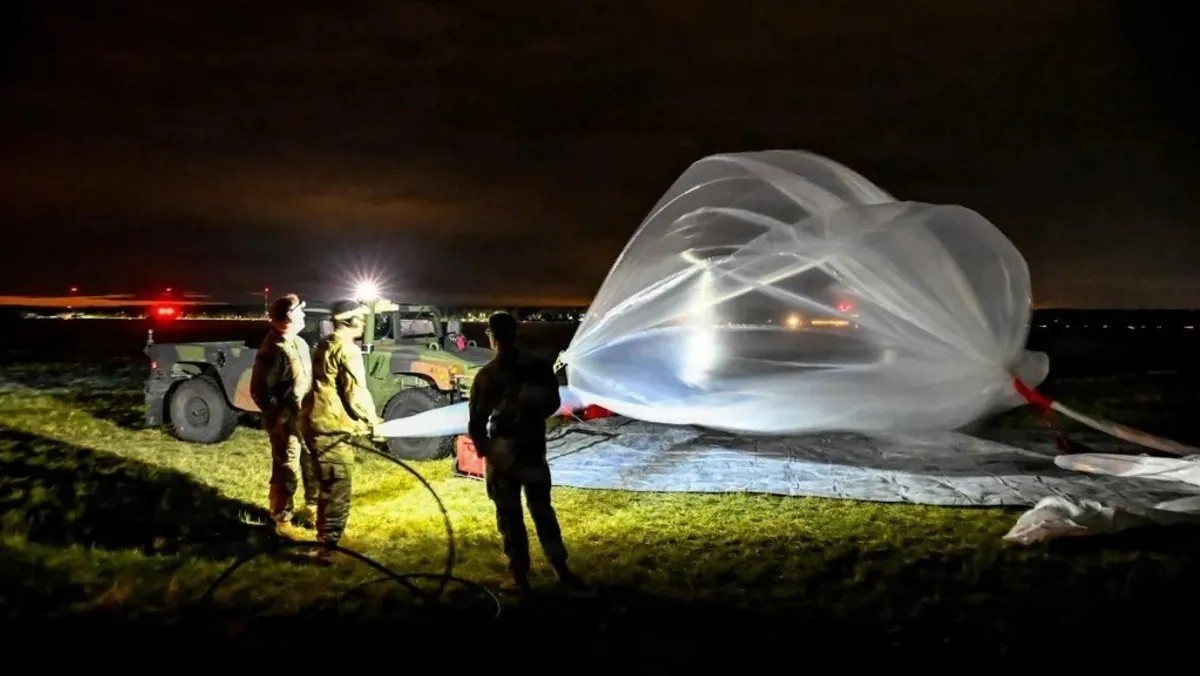
The U.S. military is exploring the use of high-altitude balloons equipped with multi-functional payloads for battlefield surveillance, communication relay, and offensive strikes, aiming to counter China's anti-access/area denial (A2/AD) strategy. China employs this strategic military doctrine to deter foreign powers, especially the United States, from freely operating near its borders and claimed territorial waters. Interest and testing of high-altitude balloons have increased in recent years, offering a cheaper and less conspicuous platform deployable from dispersed locations, according to Bernard Harrington, commander of the U.S. Indo-Pacific Command. The U.S. Air Force awarded a $64.4 million contract to Aerostar to develop a prototype high-altitude balloon to meet urgent operational requirements. These balloons serve as a cost-effective offensive tool compared to advanced missiles, providing reconnaissance, communication, and strike capabilities that are harder for adversaries to detect. The multi-domain command integrates ground maneuver elements with long-range capabilities to operate across space, cyberspace, and the electromagnetic spectrum, aiming to penetrate China's A2/AD network. High-altitude balloons act as airborne platforms deployed from manned and unmanned vehicles for various missions, enabling troops to utilize more affordable and plentiful attack drones and munitions. They can remain aloft for weeks or months with precise navigation, enhancing their value as radar and sensor platforms at operational altitudes exceeding 60,000 feet. Balloons are a cost-effective alternative to satellites, forming part of an integrated data collection system across space, air, land, and sea, compensating when space assets are disrupted. In case of foreign surveillance balloons entering U.S. airspace, Washington prefers to seize control without destruction to ensure accurate data collection and target identification. Harrington highlighted that balloons can deliver kinetic effects that may not require destroying targets but rather disabling systems to create tactical opportunities. Bayonet Quest 26 exercises tested these systems, including drone launches and data gathering using artificial intelligence and machine learning. The U.S. Navy plans to increase production of unmanned reconnaissance boats as part of broader efforts to deploy more robotic platforms against China. These technologies reduce the need for large ground troop presence by integrating multiple systems into a unified data layer for efficient coordination. Experiments with high-altitude balloons are conducted worldwide, including during Valiant Shield and Orient Shield exercises, to assess logistical and sensing capabilities. The United States leads the 2026 global military power ranking, with China positioned third. Stephen Carpenter, commander of the U.S. multi-domain command in the East, stated that these platforms help open windows of opportunity against A2/AD networks by providing flexible communications and additional strike platforms. Flight paths and optimal deployment seasons for these high-altitude systems are under study to effectively threaten enemy cities and capabilities at any time.